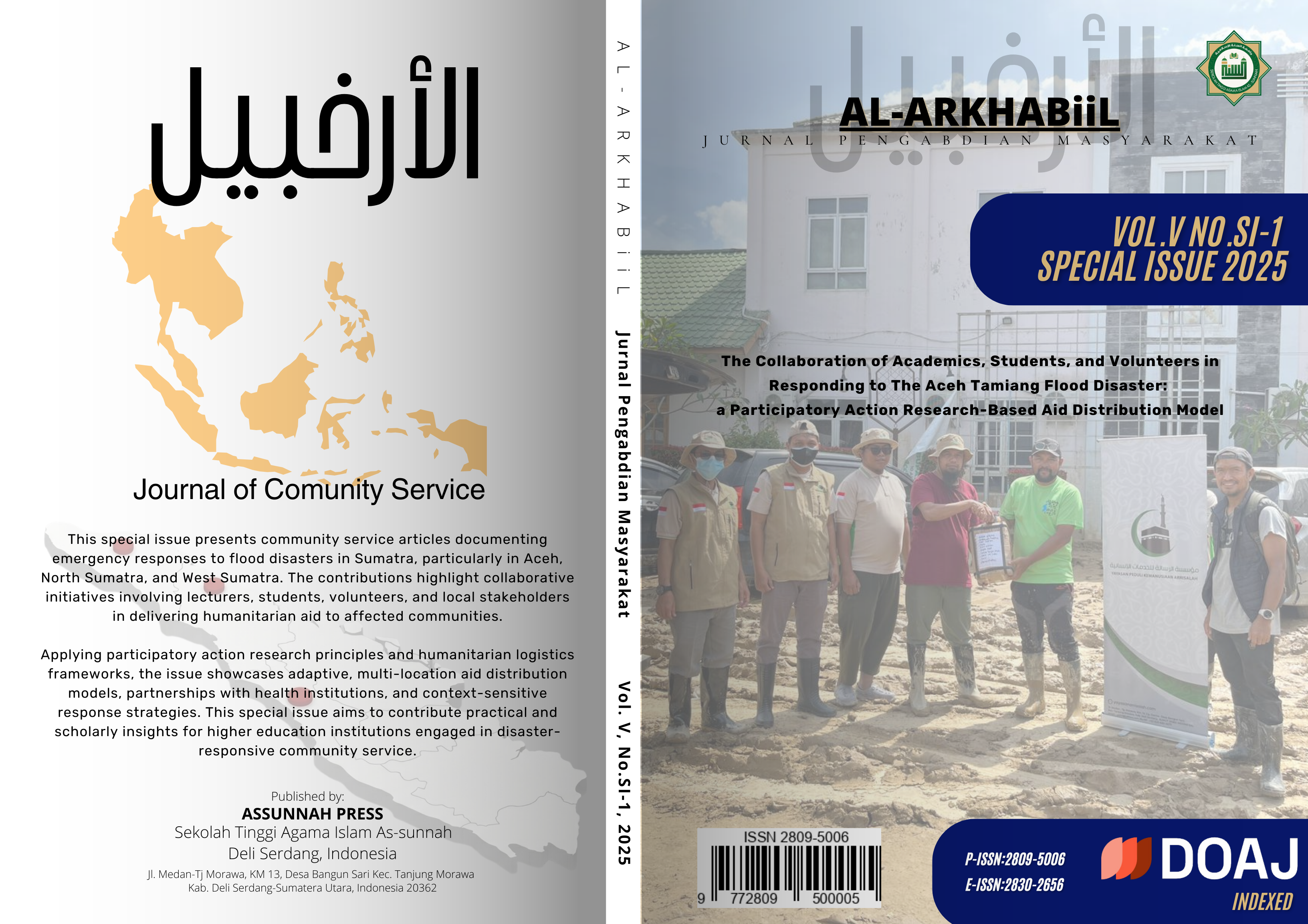
Humanitarian Aid for Flash Flood Victims in Batu Busuak: An International Collaboration between STAI As-Sunnah and Bayaan Association Singapore
DOI:
https://doi.org/10.51590/jpm_assunnah.v5iSI-1.1260Keywords:
flash flood disaster, humanitarian aid, international collaboration, Islamic philanthropy, disaster responseAbstract
The flash flood disaster that struck Batu Busuak, Padang City, in November-December 2025 caused massive damage to residential areas. Within three weeks, this area experienced four consecutive flash floods that swept away 11 houses, severely damaged 46 houses, and forced hundreds of families to evacuate. This community service activity aimed to provide humanitarian aid in the form of necessities to flood victims through international collaboration between Sekolah Tinggi Agama Islam (STAI) As-Sunnah Deli Serdang and Bayaan Association Singapore. The service partners were flood-affected communities in Koto Panjang Ikua Koto Sub-district, Koto Tangah District, and Batu Busuak, Lambung Bukik Sub-district, Pauh District, Padang City. Implementation methods included multi-institutional coordination, international fundraising, local procurement of aid, and door-to-door and distribution-point delivery. A total of IDR 57,000,000 was collected and used to procure necessity packages for 150 affected households. The activity was conducted on December 24-27, 2025, and was led directly by the Chairman of STAI As-Sunnah. The results showed that aid distribution successfully reached victims in isolated locations using adaptive methods according to field conditions. Community response was very positive despite high psychosocial trauma, where residents lived in constant vigilance against subsequent flood threats. This activity was also followed by sustainability programs, including plans to build mosques and bore wells, undertaken by Yayasan Peduli Kemanusiaan Arrisalah as long-term recovery efforts. The Singapore-Indonesia international collaboration in this activity demonstrated the effectiveness of global Islamic philanthropy networks for local emergency response.
References
Aldrich, Daniel P, and Michelle A Meyer. “Social Capital and Community Resilience.” American Behavioral Scientist 59, no. 2 (2015): 254–69. https://doi.org/10.1177/0002764214550299.
Bencana, Badan Nasional Penanggulangan. “Data Informasi Bencana Indonesia (DIBI).” BNPB, 2025. https://dibi.bnpb.go.id.
Benevolenza, Mia Alysha, and Jamie DeRose. “Meeting the Mental Health Needs of Disaster Victims: An Overview of Mental Health Relief Efforts in Asia.” International Journal of Emergency Mental Health and Human Resilience 21, no. 3 (2019): 1–14. https://doi.org/10.4172/1522-4821.1000447.
Hasan, Nurdin, and Ahmad Nizar Yogatama. “Islamic Philanthropy and Social Justice: The Role of Islamic CSR in Indonesia.” Kyoto Bulletin of Islamic Area Studies 6 (2013): 85–105.
Kompas.com. “Banjir Bandang Di Batu Busuk Padang, 47 KK Mengungsi Di Perbukitan.” 2025. https://regional.kompas.com.
Lassa, Jonatan A, Edbert Sembiring, Riyanti Djalante, and Yohanes Ginting. “Twenty Years of Community-Based Disaster Risk Reduction Experience from a Dryland Village in Indonesia.” International Journal of Disaster Risk Science 10, no. 3 (2019): 343–55. https://doi.org/10.1007/s13753-019-00222-4.
Padang, Pemerintah Kota. “Sempat Terputus, Akses Jalan Di Batu Busuk Sudah Bisa Dilewati Kendaraan Roda Dua.” 2025. https://padang.go.id.
UNISDR. Sendai Framework for Disaster Risk Reduction 2015-2030. Geneva: United Nations Office for Disaster Risk Reduction, 2015.
Usman, Muhammad Idris, Puji Lestari, Sigit Sutikno Wibowo, and Muhamad Ridwan. “Flash Flood Disaster Management in Indonesia: A Comprehensive Review.” International Journal of Disaster Risk Reduction 85 (2023): 103512. https://doi.org/10.1016/j.ijdrr.2022.103512.



_.png)