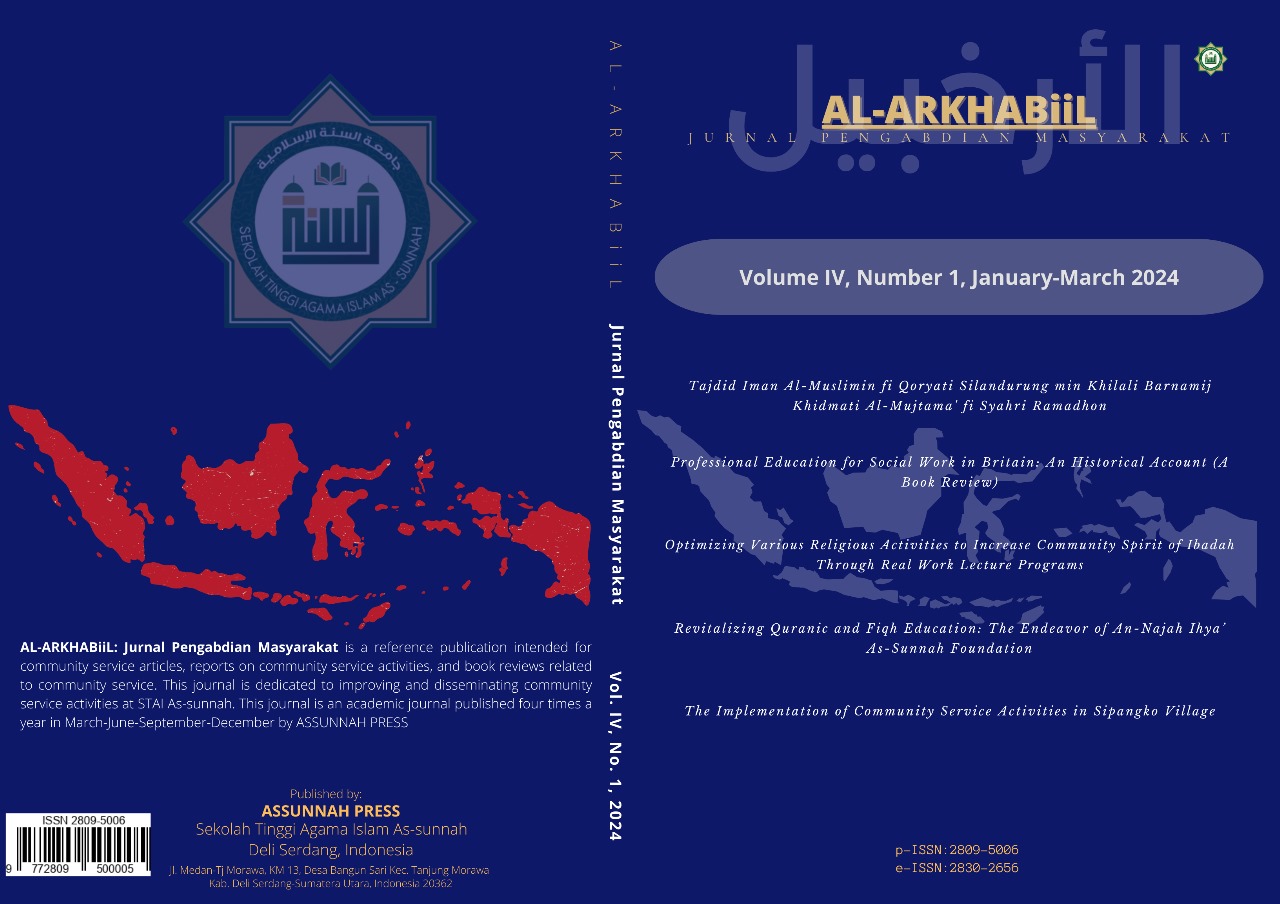
The Implementation of Community Service Activities in Sipangko Village
DOI:
https://doi.org/10.51590/jpm_assunnah.v4i1.496Keywords:
Sipangko Village, Community Service, Madrasah Diniyah Awaliyah, Tahsin QuranAbstract
Recently, the author has heard many complaints from parents, the community, educational experts, and people involved in the world of education, especially in the religious field, regarding the behavior of children who have no interest in reading and understanding the contents of the Quran and Muslim children today, especially in Sipangko Villages has begun to lose interest in things related to the Arabic language, due to their busyness with various games on their respective gadget applications. They feel that the Arabic language is old-fashioned. The method that the Researcher used was the PAR (Participatory Action Research) method, which the Researcher carried out in participation with residents. After the implementation of the program for memorizing 10 surahs and their translations as well as 50 Arabic vocabulary words, the children of Madrasah Diniyah Awaliyah (MDA) Sipangko became enthusiastic about memorizing and learning the Quran, translation of Quran and Arabic, this was proven during the evaluation which was carried out on Wednesday, April 5 2023, that of the 42 student participants, 30 of them had memorized 10 surahs and their translations along with 50 Arabic vocabulary words, while 12 students had memorized 10 surahs and their translations. 6 surahs with translations and 20 Arabic vocabulary. Moreover, the villages and parents should pay attention to the children in their education with adequate infrastructure and human resources to educate them, especially in learning the Quran and Arabic.
References
Achmadi. Ideologi Pendidikan Islam Paradigma Humanisme Teosentris. Yogyakarta: Pustaka Pelajar, 2005.
Al-Jauziyyah, Ibnu Qoyyim. Tuhfatul Muadud BI AhPenelitil Maulud. Beirut: Darul Kutub Al-Ilmiah, 1983.
Al-Quran. Attahrim, n.d.
Al-Syaibani, Omar Mohammad Al-Thoumy. Fisafat Pendidikan Islam. Jakarta: Bulan Bintang, 1979.
Hikmah, Nurul. Kurikulum Pendidikan Islam Anak Usia Dini. Tangerang: Bait Qur,any Multimedia, 2022.
Kurnaidi, Abu Ya’la, and Nizar Sa;ad Jabal. Metode Asy-Syafi’i Ilmu Tajwid Praktis. Jakarta:Pustaka Imam Syafi’i, 2020.
Makhfud, Musa. Ilmu Dakwah Dan Penerapannya. Jakarta: bulan Bintang, 2004.
Muhammad, Abu Abdurrahman. Ta’Thirul Anfas Bitta’liq A’la Washiyatinnanbi Li Ibni Abbas. Beirut: Darul Jail, 2008.
Muslim, Abul Hasan. Shohih Muslim. Beirut: Darul Jail, 1978.
Pamessangi, Andi Arif. “Optimalisasi Potensi Kecerdasan Anak Sejak Dini Dalam Belajar Bahasa Arab.” Ejournal.Iainpalopo 3.No 2 (2020).
Setiawati. “Meningkatkan Keterampilan Pengucapan Siswa Melalui Teknik Membaca Keras.” SEMNARA 2 (2019).
Sholihuddin. “Pendampingan Metode Takrir Dan Sambung Ayat Dalam Meningkatkan Daya Ingat Hafalan Santri.” Journal of Community Engagment 02 N0 1 (2022).



_.png)