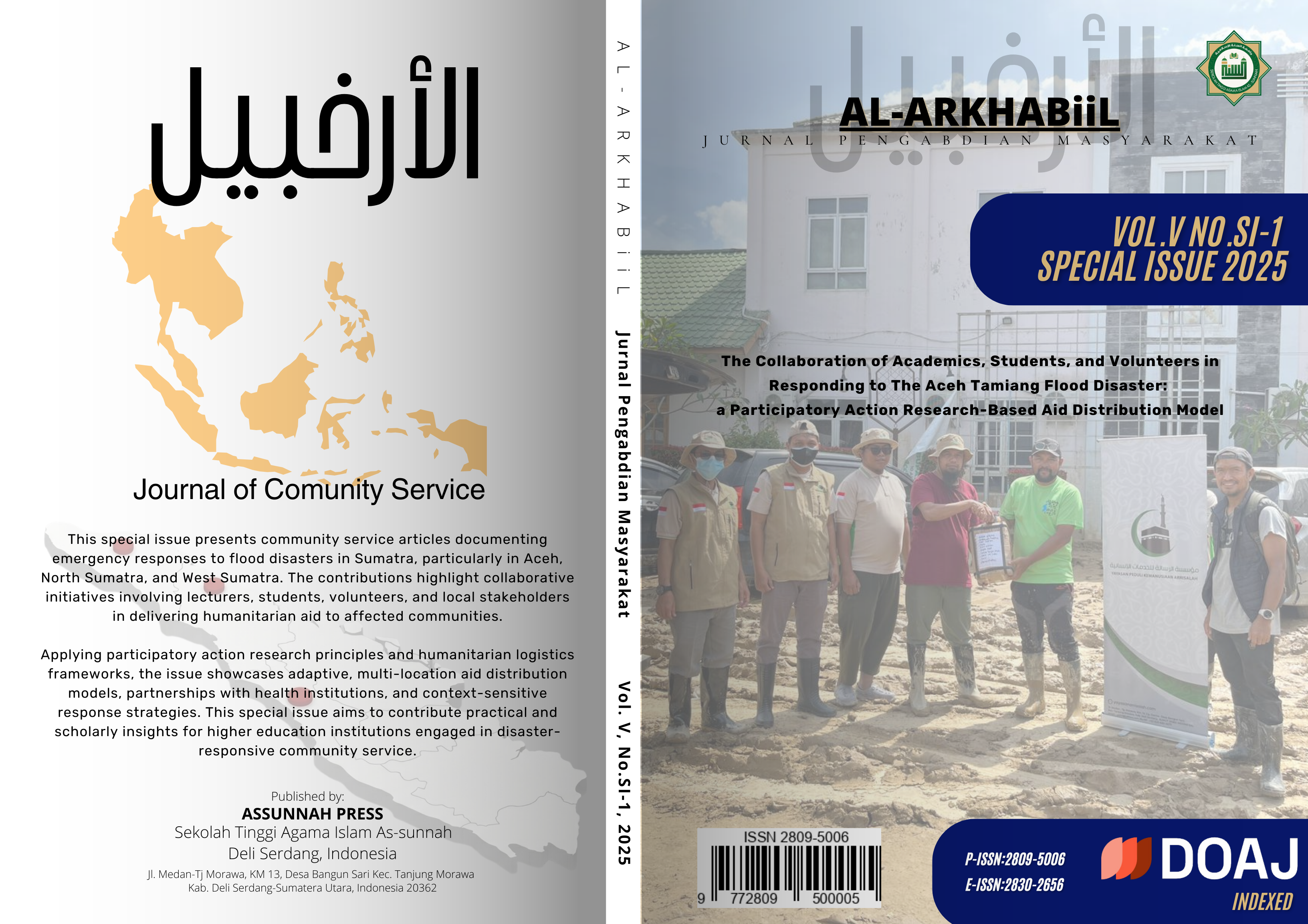
The Collaboration of Academics, Students, and Volunteers in Responding to The Aceh Tamiang Flood Disaster: a Participatory Action Research-Based Aid Distribution Model
DOI:
https://doi.org/10.51590/jpm_assunnah.v5iSI-1.1200Keywords:
flood, humanitarian aid, Aceh Tamiang, community service, disaster response, humanitarian logistics, collaborative governanceAbstract
The floods that hit Aceh Tamiang Regency, Nanggroe Aceh Darussalam Province in November 2025 have seriously affected people's lives. Thousands of homes were submerged, access roads were cut off, infrastructure was damaged, and it's been hard to supply people's basic needs. This emergency situation requires a quick and coordinated response from various parties, including colleges and universities. This community service project aims to provide humanitarian assistance to flood victims through the distribution of basic food supplies, medicines, and other essential items. The partners in this community service project are the flood-affected communities in four locations (Buluh Butung Village, Purwodadi, Kota Lintang Bawah, and Landu) and the Aceh Tamiang Regional General Hospital. The method used is adapted from the principles of participatory action research, which includes team coordination, fundraising, procurement of aid, and distribution through direct delivery, assembly points, and door-to-door visits. The implementation team consisted of 42 people (7 lecturers, 5 students, and 30 volunteers) who successfully raised Rp 138,500,000. The activities were carried out on 5 and 8 November 2025 at five distribution points. The results of the community service programme show that 270 households (approximately 855 people) successfully received assistance in the form of 250 food packages, hundreds of bales of clothing, thousands of medicines and medical supplies, and other essential items. The community responded very positively with great enthusiasm, and the distribution ran smoothly. Feedback from beneficiaries indicated that the food parcels and medicines were highly effective in providing basic necessities, although there were still ongoing needs such as emergency tents, sleeping equipment, and water storage containers. This community service initiative demonstrated the importance of collaboration between colleges or universities, students, and volunteers in rapid disaster response, as well as the effectiveness of multi-location distribution adjusted to actual conditions on the ground.
References
(BNPB), Badan Nasional Penanggulangan Bencana. Indeks Risiko Bencana Indonesia (IRBI) Tahun 2023. Jakarta: BNPB, 2023.
(CARRI), Community and Regional Resilience Institute. “Definitions of Community Resilience: An Analysis.” Oak Ridge: CARRI, 2013.
Adger, W Neil. “Social and Ecological Resilience: Are They Related?” Progress in Human Geography 24, no. 3 (2000): 347–64. https://doi.org/10.1191/030913200701540465.
Afandi, Agus. Modul Participatory Action Research (PAR) Untuk Pengorganisasian Masyarakat (Community Organizing). Surabaya: Lembaga Penelitian dan Pengabdian Masyarakat (LPPM) UIN Sunan Ampel, 2016.
Afandi, Agus, Isnantia Sulistyani, Abdul Muhid, Rokhmadi, and Khilmi Safa’ah. Dasar-Dasar Pengembangan Masyarakat Islam. Surabaya: IAIN Sunan Ampel Press, 2013.
al-Attas, Syed Muhammad Naquib. The Concept of Education in Islam: A Framework for an Islamic Philosophy of Education. Kuala Lumpur: International Institute of Islamic Thought and Civilization (ISTAC), 1999.
Al-Attas, Syed Muhammad Naquib. The Concept of Education in Islam: A Framework for an Islamic Philosophy of Education. Kuala Lumpur: ABIM, 1980.
al-Ghazālī, Abū Ḥāmid Muḥammad ibn Muḥammad. Iḥyā’ ’Ulūm Al-Dīn. Vol. 4. Beirut: Dār al-Ma’rifah, n.d.
al-Qaraḍāwī, Yūsuf. Al-Ṣabr Fi Al-Qur’ān. Kairo: Dār al-Shurūq, 1997.
———. Fiqh Al-Zakāh: Dirāsah Muqāranah Li-Aḥkāmihā Wa Falsafatihā Fī Ḍaw’ Al-Qur’ān Wa Al-Sunnah. Vol. 2. Beirut: Mu’assasat al-Risālah, 1973.
al-Ṣadr, Muḥammad Bāqir. Iqtiṣādunā. Beirut: Dār al-Ta’āruf, 1987.
al-Zuḥaylī, Wahbah. Al-Fiqh Al-Islāmī Wa Adillatuh. Vol. 4. Damaskus: Dār al-Fikr, 1989.
Aldrich, Daniel P. Building Resilience: Social Capital in Post-Disaster Recovery. Chicago: University of Chicago Press, 2012.
Ansell, Chris, and Alison Gash. “Collaborative Governance in Theory and Practice.” Journal of Public Administration Research and Theory 18, no. 4 (2008): 543–71. https://doi.org/10.1093/jopart/mum032.
Ardhana, I Putu Gede. “Collaborative Governance Dalam Penanggulangan Bencana Banjir Di Kota Denpasar.” Jurnal Administrasi Publik 8, no. 2 (2021): 187–201.
Azizah, Istiqomah Nur, Cacuk Sudarsono, and Lukman Hakim. “Challenges in Humanitarian Logistics: A Systematic Literature Review.” Jurnal Sistem Dan Manajemen Industri 6, no. 1 (2022): 43–54. https://doi.org/10.30656/jsmi.v6i1.4238.
Boyer, Ernest L. Scholarship Reconsidered: Priorities of the Professoriate. Princeton: Carnegie Foundation for the Advancement of Teaching, 1990.
Gramsci, Antonio. Selections from the Prison Notebooks. Edited by Quintin Hoare and Geoffrey Nowell Smith. New York: International Publishers, 1971.
Ibn ’Āshūr, Muḥammad al-Ṭāhir. Maqāṣid Al-Syarī’ah Al-Islāmiyyah. Yordania: Dār al-Nafā’is, 2001.
Indonesia, Republik. “Undang-Undang Republik Indonesia Nomor 12 Tahun 2012 Tentang Pendidikan Tinggi,” 2012.
Kementerian Pendidikan Tinggi dan Teknologi, Sains. “Kemdiktisaintek Konsolidasikan Program Pengabdian Masyarakat Tanggap Darurat Bencana Sumatra,” December 11, 2025.
Kemmis, Stephen, and Robin McTaggart. “Participatory Action Research: Communicative Action and the Public Sphere.” In The SAGE Handbook of Qualitative Research, edited by Norman K Denzin and Yvonna S Lincoln, 3rd ed., 559–603. Thousand Oaks: SAGE Publications, 2005.
Khaldūn, Ibn. Muqaddimah Ibn Khaldūn. Edited by ’Alī ’Abd al-Wāḥid Wāfī. Kairo: Dār Nahḍat Miṣr, 2006.
Kovács, Gyöngyi, and Karen M Spens. “Humanitarian Logistics in Disaster Relief Operations.” International Journal of Physical Distribution & Logistics Management 37, no. 2 (2007): 99–114. https://doi.org/10.1108/09600030710734820.
McTaggart, Robin. “Participatory Action Research: Issues in Theory and Practice.” Educational Action Research 2, no. 3 (1994): 313–37. https://doi.org/10.1080/0965079940020302.
Nurjanah, Siti. “Efektivitas Distribusi Bantuan Bencana: Studi Kasus Gempa Lombok 2018.” Jurnal Manajemen Bencana 4, no. 1 (2020): 23–35.
Nurjanah, Sugiharto, Dede Kuswanda, Siswanto, and Cecep Adikoesoemo. Manajemen Bencana. Bandung: Alfabeta, 2012.
Putnam, Robert D. “Bowling Alone: America’s Declining Social Capital.” Journal of Democracy 6, no. 1 (1995): 65–78. https://doi.org/10.1353/jod.1995.0002.
Rafliana, Irina, Fatemeh Jalayer, Andrea Cerase, Lorenzo Cugliari, Marco Baiguera, Dimitra Salmanidou, Orcun Necmioglu, Mehmet Aydin, Andreas Hoechner, and Malvina Scardapane. “Tsunami Mitigation Through Participatory Action Research in Indonesia: A Decade of Lesson Learned.” International Journal of Disaster Risk Reduction 64 (2021): 102479. https://doi.org/10.1016/j.ijdrr.2021.102479.
Rahmafitria, Fitri, Vevi Sukmayadi, Hadi Purboyo, and Sri Mardiah. “Community Resilience: A Review of Definitions, Assessments, and Barriers and Strategies.” Sustainability 14, no. 20 (2022): 13155. https://doi.org/10.3390/su142013155.
Reason, Peter, and Hilary Bradbury. The SAGE Handbook of Action Research: Participative Inquiry and Practice. 2nd ed. London: SAGE Publications, 2008.
Riḍā, Muḥammad Rashīd. Tafsīr Al-Manār. Vol. 6. Kairo: al-Hay’ah al-Miṣriyyah al-’Āmmah li al-Kitāb, 1990.
Salleh, Muhammad Syukri. Pembangunan Berteraskan Islam. Bangi: Penerbit Universiti Kebangsaan Malaysia, 2016.
Samekto, F X Adji. “Dampak Sosial-Ekonomi Bencana Banjir Terhadap Masyarakat.” Jurnal Pembangunan Wilayah Dan Kota 13, no. 3 (2017): 365–76. https://doi.org/10.14710/pwk.v13i3.17692.
Santosa, Heru, and Rizki Amalia. “Peran Mahasiswa Dalam Pengabdian Masyarakat Berbasis Bencana.” Jurnal Pengabdian Masyarakat 5, no. 3 (2021): 298–310.
Santoso, Budi, and Ahmad Rusdiansyah. “Sistem Informasi Logistik Bencana Untuk Koordinasi Distribusi Bantuan.” Jurnal Teknik Industri 18, no. 2 (2020): 145–56.
Shihab, M Quraish. Tafsir Al-Mishbah: Pesan, Kesan, Dan Keserasian Al-Quran. Vol. 7. Jakarta: Lentera Hati, 2002.
Spillane, James P. Distributed Leadership. San Francisco: Jossey-Bass, 2006.
UNISDR. Sendai Framework for Disaster Risk Reduction 2015-2030. Geneva: United Nations Office for Disaster Risk Reduction, 2015.
Wassenhove, Luk N Van. “Humanitarian Aid Logistics: Supply Chain Management in High Gear.” Journal of the Operational Research Society 57, no. 5 (2006): 475–89. https://doi.org/10.1057/palgrave.jors.2602125.
Wyngaard, Guido Van, J H C Pretorius, and Leon Pretorius. “Emergency Relief Logistics: Optimization Model for Goods Distribution.” In Proceedings of the 2015 Annual Conference of the South African Institute of Computer Scientists and Information Technologists, 1–8. New York: ACM, 2015.



_.png)