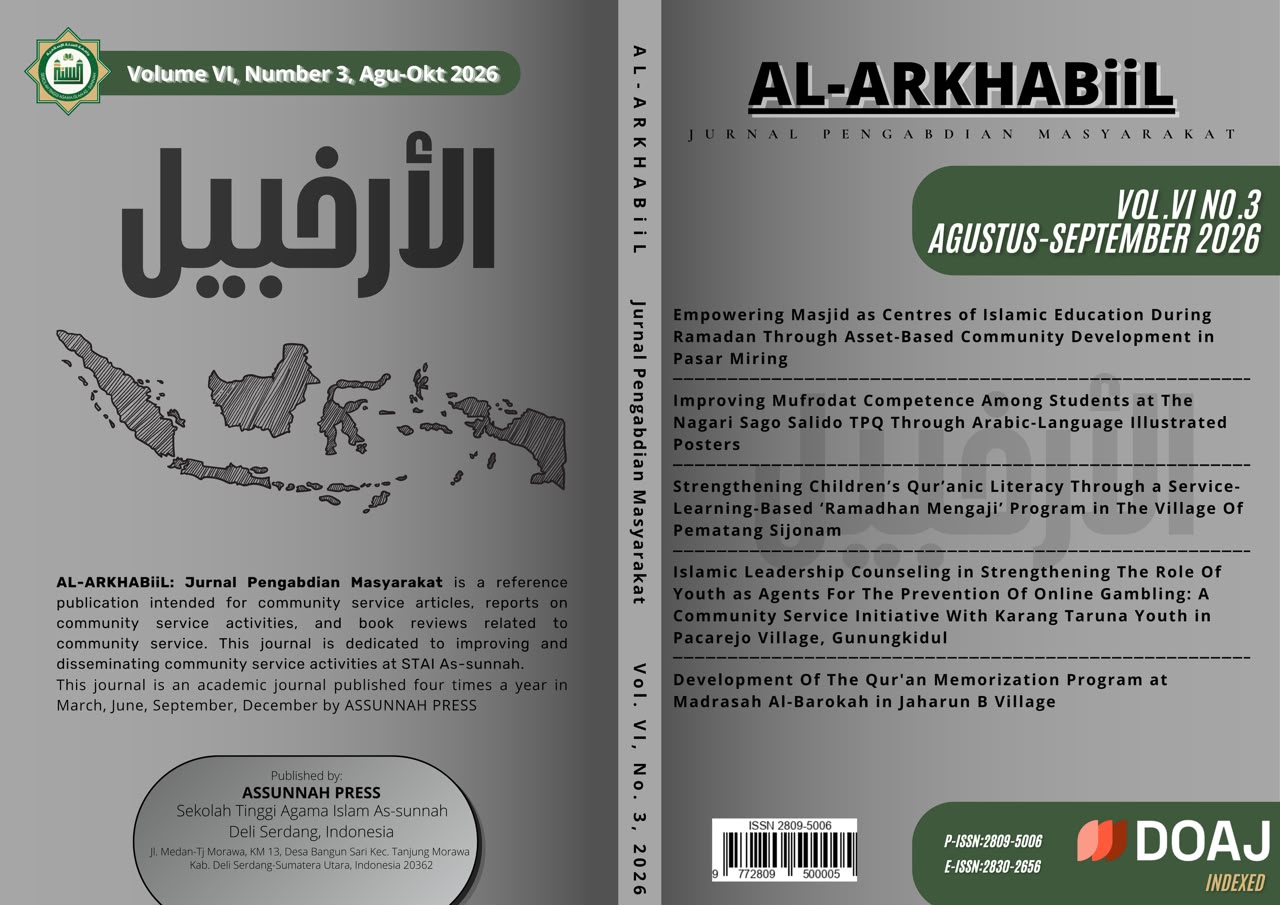
Empowering Masjid as Centres of Islamic Education During Ramadan Through Asset-Based Community Development in Pasar Miring
DOI:
https://doi.org/10.51590/jpm_assunnah.v6i3.1280Keywords:
Asset-Based Community Development, KKNT, Masjid Empowerment, Islamic education, tahsinAbstract
Masjid in rural Indonesia are frequently treated as ritual spaces alone, although they hold sufficient physical, social, and spiritual capital to sustain non-formal Islamic education. This article reports the thematic community service programme (KKNT) of Group 25, STAI As-Sunnah Deli Serdang, at Masjid Amaliyah, Dusun Gotong Royong, Pasar Miring Village, Pagar Merbau District, Deli Serdang Regency, North Sumatra, conducted over thirteen days during Ramadan 1447 H (21 February–5 March 2026). Programme partners comprised the Masjid Amaliyah management, the Rumah Qur’an Shofiyyah administrators, SDN 105352 Pasar Miring, and the Pasar Miring Village Government. The programme applied the Asset-Based Community Development (ABCD) approach through five stages, discovery, dream, design, define, and destiny, positioning the masjid as the core asset rather than community deficits as the point of departure. Data were gathered through participant observation, pre- and post-programme oral tahsin assessment, daily field notes, and visual documentation. Fifteen programmes were delivered across 35 scheduled sessions, generating approximately 1,856 participant-sessions drawn from an estimated 400 to 450 individual beneficiaries; the two metrics are reported separately because attendance was recorded without unique-identity tracking. Findings indicate improved application of mim sakinah and qalqalah rules among women participants, increased children’s engagement in Qur’anic literacy, the establishment of a literacy corner and permanent visual da’wah media at the masjid, and the masjid management’s willingness to continue the halaqah independently. The study affirms that Ramadan constitutes a measurable window of receptivity rather than a scheduling coincidence, and that asset-based framing yields more equitable partnership relations than deficit-based framing.
References
Afandi, Agus, Nurul Lally, and Nur Wahyudi. Metodologi Pengabdian Masyarakat. Jakarta: Direktorat Pendidikan Tinggi Keagamaan Islam, Kementerian Agama RI, 2022.
Al-Bukhari, Muhammad bin Isma’il. Al-Jami’ al-Sahih min Hadits Rasulillah wa Sunanihi wa Ayyamihi. Kairo: Al-Maktabah As-Salafiyah, 1400.
Alim, Muhammad Nur, Dian Amand Nasution, Fauzan Agung Pratama, Ikhlasul Amal Wishri, Muhammad Nugraha, Maulana Ahmad Abadi, Tri Hidayatullah, Taufik Hidayat, and Wizhar Al Giffari. “Improving Literacy of Fiqh Muamalah and Islamic Economics Through Community-Based Research Method.” Al-Arkhabiil: Jurnal Pengabdian Masyarakat 4, no. 2 (2024): 1–12. https://doi.org/10.51590/jpm_assunnah.v4i2.783.
Dona, S R, Sukma Widya Puspita, Nurul, Raisa Azyana, Rahmawita, Syahfitri Arika, and Riza Maulida. “Implementing Asset-Based Community Development (ABCD) Approach in Enhancing Qur’anic Literacy Through Tahsin Learning at Gampong Meunasah, Bireuen, Aceh: A Community-Based Participatory Action Research.” Al-Arkhabiil: Jurnal Pengabdian Masyarakat 5, no. 2 (2025): 113–31. https://doi.org/10.51590/jpm_assunnah.v5i2.1061.
Gunawan, Candra, Abdi Aldila Putra, Raihan Shidqi Ra’uf, Yasirli, and Vedrand Gilang Wahyudi Haris. “Baliak Ka Surau: An Action Research to Empower Masjid to Learn Islamic Science in Kampuang Sarugo.” Al-Arkhabiil: Jurnal Pengabdian Masyarakat 3, no. 2 (2023): 1–14. https://doi.org/10.51590/jpm_assunnah.v3i2.527.
Hidayati, Tri Wahyu, and M Gufron. “The Qur’anic Education Strategies for the Indonesian Context: An Investigation of the Halaqah of the Qur’an in Mecca and Medina.” International Journal on Advanced Science, Education, and Religion 7, no. 4 (2024): 44–59. https://doi.org/10.33648/ijoaser.v7i4.733.
Iqbal, Muhammad, and Putri Larasia. “Implementation of the Tahsin Al-Qur’an Program Using the Talaqqi Method for the Community of Nagari Durian Tinggi, Kapur IX District, Lima Puluh Kota Regency, West Sumatra.” Al-Arkhabiil: Jurnal Pengabdian Masyarakat 5, no. 1 (2025): 22–34. https://doi.org/10.51590/jpm_assunnah.v5i1.660.
Lukman, Fadhli. “Digital Hermeneutics and A New Face of The Qur’an Commentary: The Qur’an in Indonesian’s Facebook.” Al-Jami’ah: Journal of Islamic Studies 56, no. 1 (2018): 95–120. https://doi.org/10.14421/ajis.2018.561.95-120.
Mathie, Alison, Jenny Cameron, and Katherine Gibson. “Asset-Based and Citizen-Led Development: Using a Diffracted Power Lens to Analyze the Possibilities and Challenges.” Progress in Development Studies 17, no. 1 (2017): 54–66. https://doi.org/10.1177/1464993416674302.
Muhtarom, Ali. “Participation Action Research dalam Membangun Kesadaran Pendidikan Anak di Lingkungan Perkampungan Transisi Kota.” Dimas: Jurnal Pemikiran Agama untuk Pemberdayaan 18, no. 2 (2018): 259. https://doi.org/10.21580/dms.2018.182.3261.
Shalihin, Nurus, Firdaus Firdaus, Yulia Yulia, and Ujang Wardi. “Ramadan and Strengthening of the Social Capital of Indonesian Muslim Communities.” HTS Teologiese Studies / Theological Studies 76, no. 3 (2020): 1–9. https://doi.org/10.4102/hts.v76i3.6241.
Shalihin, Nurus, and Muhammad Sholihin. “Ramadan: The Month of Fasting for Muslim and Social Cohesion-Mapping the Unexplored Effect.” Heliyon 8, no. 10 (2022): e10977. https://doi.org/10.1016/j.heliyon.2022.e10977.
Tumanggor, Ilham, Hasbi Ramadani, and Candra Gunawan. “Talaqqi and Takrir Methods in Improving the Quality of Reading & Memorizing the Qur’an.” Al-Arkhabiil: Jurnal Pengabdian Masyarakat 2, no. 2 (2022): 19–27. https://doi.org/10.51590/jpm_assunnah.v2i2.284.
Tumanggor, Ilham, Abdul Raafi, and Muhammad Riannur Hidayah. “Ramadan Da’wah Safari in Improving Motivation to Learn the Qur’an.” Al-Arkhabiil: Jurnal Pengabdian Masyarakat 3, no. 3 (2023): 23–30. https://doi.org/10.51590/jpm_assunnah.v3i3.525.
Ulum, Bahrul, Satri Yarnis, Jihan Chairatunnisa, Luthfia Rahma, Fitria Nur Ikhsani, Siti Aminah Nasution, and Vira Milta Rusdy. “Enhancing Islamic Educational Outcomes through Community-Based Research: A Ramadan Intervention Program at Pondok Tahfidz Az-Zikri.” Al-Arkhabiil: Jurnal Pengabdian Masyarakat 5, no. 1 (2025): 1–11. https://doi.org/10.51590/jpm_assunnah.v5i1.740.
Wajdi, M Barid Nizarudin, R Sa’adillah S.A.P., L Ana Ferawati Ekaningsih, H Syaiful Rizal, and A Fathurrohman. “Asset-Based Community Development: Leveraging Local Strengths for Empowering Communities: A Bibliographic Analysis.” Engagement: Jurnal Pengabdian Kepada Masyarakat 8, no. 1 (2024): 308–25. https://doi.org/10.29062/engagement.v8i1.1784.
Downloads
Published
Issue
Section
License
Copyright (c) 2026 Rozaanah Rozaanah, Salwa Salsabila Daulay, Anisa Maulidya, Athiyah Sakinah, Delti Hidayati

This work is licensed under a Creative Commons Attribution 4.0 International License.



_.png)